Saturday, September 29, 2012

The Indie Book Review: Liberation at 50 Paces

As regular readers of this blog know, I've got a soft spot for westerns. Something about the archetypical dusty town out west where good versus evil gets settled with six guns makes me very happy. And I've also got a fondness for steampunk.

So, Liberation at 50 Paces, a western steampunk short story, was set perfectly to make me a very happy reader. Not only do we have the dusty town and a duel, but there's also pitch perfect western voice. Oh yes, very happy Keryl over here.

Now, full disclosure time here. I know and like Jarod Crews. He didn't ask me for a review, nor did he read this before it went live.

Okay, now that's out of the way, let's talk about Liberation.

First off, it's a novelette. Though, being of an old-school turn of mind, I'd call it a short story. Either way, we're talking about an hour or so of easy reading.

People who are wary of short stories often complain about the fact that it's hard to really get to know a character in such a tiny bit of space. And I'll admit, as a writer, I consider that the number one challenge for writing a short story. There are a number of tricks for how to get character across quickly, foremost among them a distinctive voice, and in Liberation, Crews absolutely nailed the voice.

Less than five paragraphs in you feel like you know Hanson, (the main character) because his voice is so clear, so perfectly unique. Honestly, and this probably says as much about my geek cred as Crews' writing style, the western voice was so well done, when I was reading, I could hear Nathan Fillion's Malcolm Reynolds speaking.

For short stories, plot is often the next level of concern. Many short stories don't really have one. They're more prose poems than actual tales. And, while I'm a character reader, I do have to have something happen to keep me enjoying a tale.

I was pleased to see there was a distinct plot arc for Liberation. At first glance, the plot is fairly generic. Boy meets beautiful girl, boy falls into insta-love with beautiful girl, boy does something stupid for girl, girl's very powerful husband is understandably upset about the whole thing. And I'll admit, I was starting to get worried that this was going to be a great character trapped in a blah story, and then Crews pulled out a fabulous twist at the end, making me very, very happy.

Do I have quibbles about this? Sure. (When don't I?)

The story revolves around the idea of freedom. And that's a great theme, especially for a Western. Still, I would have liked to have seen more done with it. Hanson lives in a slave trading town, which he hates. It's a symbol for both Hanson's personal feelings of being bound, and also a meta for how damaged and constraining the world this story is set in is. Yes, this is a short story, but a thousand or so more words would have fully cemented this theme into place and given us a bit more concrete motivation for Hanson's actions.

The steampunk aspect of this story is just setting. It's cool setting, with some really interesting gizmos that are fabulous, but, nothing about it is vitally important to the plot. This could have been written as a straight western set in Texas in 1859 and would have worked just as well.

Lastly, I'm not entirely sure how old Hanson is. I know he's over sixteen (his sixteenth birthday gets mentioned). But he veers from acting very childish to very adult. His father refers to him as a boy. His voice sounds adult (most of the time). He's certainly gotten himself into a very adult situation.  I guess the reason this bothers me is that the voice I hear speaking in my mind is that of a full adult, and then he turns around and does something that seems suitable for a teenager.

As I said, quibbles.

On the whole, this is a very fine bit of short story writing. It's well worth the hour of reading time.

Sunday, June 17, 2012

Character Interview: Six

I'd been looking forward to getting to know Six a bit better since I first saw the cover of her novel. It's gripping, to say the least. And honestly, I'm a little intimidated. An angel out of Hell come to earth to battle creatures that destroy human souls, I know when I'm out of my depth. But there's something about the eyes in that picture, something I wanted to get to know more about.

After a bit of footwork, I find myself in Atlanta, sitting in an apartment across a kitchen table from a shy-looking woman who is, actually, a bit on the ordinary side. Jeans, T-shirt, strong, attractive features, but there's nothing that shouts ANGEL about her. (I'd kind of been hoping for wings, but I guess they don't exactly blend. Apparently they are tucked away.)

Her voice is soft and eye contact fleeting as we get to know each other. But as she warms up and gets a little less self-concious through the interview, I see flashes of a brilliant lady getting the lay of the land in a new place.

KR: How did you meet your author?

S: I banged on the inside of her head until she agreed to write my story. At my nagging, she dropped another project to focus on me.

KR: Do you think your author is doing a good job of capturing who you are?

S: Absolutely. I'm not an easy person to get along with. I admit that I can be moody and bitter. My author doesn't seem to mind. She writes me just the way I am.

KR: What was your favorite scene in the book? Least favorite scene?

S: My favorite scene was when I visited a human bar. The bar owner had a beautiful, lopsided smile. He smelled like mint--fresh and earthy. I liked him.

My author has asked me not to discuss my least favorite scene. I wouldn't normally take commands from her, but she promised to let me stay out of Hell for a while if I agreed. She's on my bad side right now.

KR:  Are you hoping for a sequel?

S: I've already demanded a sequel. My author promised me that the next book will be longer. It's a bigger story and will take more pages to tell. I'll give you a hint: All those demons and monsters who escaped from Hell before me are tired of hiding. They're stronger and scarier than humans, and they won't be happy unless they're causing trouble.
KR: If you could change anything in the book, what would it be?

S: I'd make the big decisions faster. Going from Hell to Earth was a tough transition. In Hell, I learned to accept the bad stuff because that's all there was. I had a hard time breaking out of that pattern when I got to Earth. People got hurt as a result. I didn't want that.
KR: What's your favorite food?

S: Bacon! So crispy and greasy. I don't know what Heaven is like, but I bet there's bacon there.

KR: You and me both, Six. So, If they ever make a movie of your book, who is playing you? If there is ever an audiobook, who do you want to do your voice?

S: I don't know who would do my voice, but I'd like Megalyn Echikunwoke (http://www.imdb.com/name/nm0248461/) to play me in a movie. She plays tough women who are both sensitive and screwed up. She suits me!

KR: Now that the book is done, what's next for you?

S: Look out for the sequel. I'll continue to find my role on Earth and discover who I want to be. And of course, I'll be fighting bad guys!
We wrap our conversation, and I head back out into the Atlanta summer. I wonder briefly if part of the appeal of Atlanta to Six is the heat, does it feel somewhat familiar to her, but don't turn around to ask. 

Saturday, May 26, 2012

Meet Constance


Constance Pruitt (Hellen Grace, Kate Chase, and many, many other names) is just a typical vampire. Except for the snark and hunting and eating other vamps. She agreed to do this interview because I promised her I'd write a story with a Vlad in it for her.

KR: So, thanks for the interview.

CP: No problem. You realize you're talking to yourself, right?

KR: I had noticed that. Though we do have different voices.

CP: True.

KR: Want to tell them all a little about Hunter's Tales?

CP: Hmmmm... Well, let's see... If I don't talk about it, what happens?

KR: I write a story where you have to go back to high school, and just sit through hour after hour of calculus.

CP: Hunter's Tales is a series of short stories about me. The one that's out now (and free on 5/25 and 5/26 here) is about my latest trip to high school.

KR: Aren't you over 350? What are you doing in high school?

CP: I like to hunt other vampires. We're a tasty breed. Prey animals are all twitchy and nervous, makes them sort of bitter. But vamps are top predators. They don't think anything is stalking them, so they're pretty relaxed, makes them taste better. Plus there's nothing more fun than hunting something that's as strong, as smart, and as fast as you are. On top of that turning the tables on something that thinks it's invulnerable adds an extra bit of fun to the hunt.

KR: It's been a while since I was in high school, but I don't remember it being a hot bed of vampiric activity. So, why high school?

CP: It wasn't back when you were there. But thanks to Joss, Stephanie, and the Vampire Diaries lady (I can never remember her name.) the teeny boppers are all Yay! Vampires! and trying to find an immortal love of the ages with their very own Cullen.

KR: I take it you don't approve.

CP: Just a tad. The Cullen wannabes... (Constance shudders.) I consider it an honor and a duty as a vamp to destroy any undead twit sprinkling himself with glitter so he'll sparkle properly.

Look, vamps aren't stupid, and a lot of them are pretty lazy. The easier food is to get, the better. So some of them have decided high school is a great place to find a compliant, steady feed. Someone who will provide them with a long term snack and adore them unconditionally. I like to go in, look like that girl, and then, when he's sure I'm ready to be let in on his "big secret" and made into a snack, I turn the tables on him.

It's fun.

KR: So you don't eat humans?

CP: Rarely. A vamp hunt may take long time, and I might get peckish, but for the most part these days I just eat vamps.


KR: So, you're what, a cross between Blade and Hannibal Lecter?

CP: You wrote me. Am I?

KR: Well, I'd say you're somewhere between Sherlock Holmes (the new version with Benedict Cumberbatch), Hannibal Lecter, and Dexter, with a Burn Notice sort of story structure.

CP: I can see that.

KR: Who's the guy on the cover? Is he a "Cullen?"

CP: Do you see any sparkles? Let's just say, he's what's makes this next high school interesting.

KR: Ahhh... Well, thanks for the interview. I think everyone has a bit of an idea of who you are.

CP: (Smirking) No problem. Out of curiosity, do you talk to yourself regularly?

KR: I'm an author. I talk to myself all the time.

CP: So this sort of thing isn't abnormal for you?

KR: Nope.

If you'd like to get to know Constance better, Hunter's Tales is available for free today on Amazon.

Tuesday, May 15, 2012

Indie Book Review: The Converted

A man with a dark past escapes to a new land hoping for a new life and atonement for past sins. Welcome to one of the great Western tropes. Many careers have been made on this basic plot, and I'm thinking C. R. Hindmarsh, author of The Converted, might be one of them as well.

Hindmarsh adds some new twists to the tale; it's not precisely a Western, in that it appears to be set in a fantasy world.  But it's a fantasy world with trains, guns, a mostly 1880s tech level, wilderness, Indians (Skia), and a powerful elite. There's even the local mayor who stands up to the rampaging savages, soldiers who don't really know what's going on where they are, and a stand off at a public hanging.

So, all in all, everything everyone loves about Westerns are in this book. If it takes place in New Alania instead of Wyoming, well, who really cares?

The twist, instead of a dark past of Civil War crimes (or heroics) our Dark Hero was a failed geneticist, whose experiments killed a slew of children.

It's a good twist. Everything other than the genetics looks pretty well set for the 1880s, but the rich and powerful have figured out how to vert (convert) genes and are walking around with different colors, different skin types (scales for example). It's not so much that the powerful have more money, they're practically a different species by the time this story gets going.

But of course, there's a dark secret involving the verts and the rich and powerful. And it's the job of the hero to get to the bottom of it and seek redemption along the way.

The cast of characters is wide enough to cover almost all of the basic Western roles. There was no whore with a heart of gold, but I think that was the only one who was missing.  They are competently drawn, interesting, and worth following.

This is a tidy and solid western. (Even if it looks a little different.)  If the drifter, one step ahead of the law, rides into town, finds things aren't the way they should be, grows a spine and a conscience, and then, with the aid of a few new friends, goes in and saves the day, overthrowing the corrupting influence is your idea of a good time, go read The Converted, you will enjoy it.

Saturday, April 28, 2012

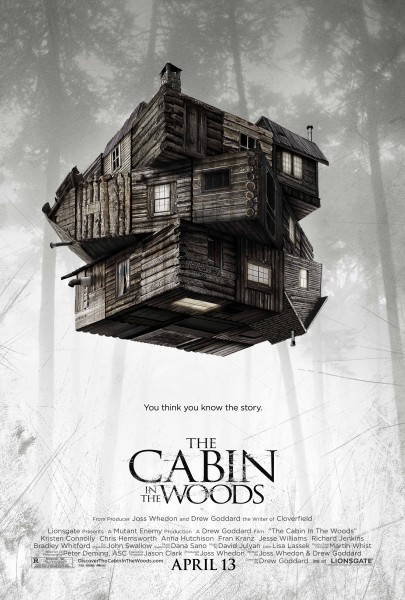
Story Teller's Art: The Cabin In The Woods

Okay, so it's not much of a secret that I think Joss Whedon is one of the greatest working story tellers.  Now, sure, he uses mainly visual media, but we novelists can still learn quite a bit from what he's doing.

Specifically, we can learn from The Cabin in the Woods, which is not just an absolutely brilliant bit of cinema, but it's also a really fine bit of storytelling. (Go see it if you haven't, and take notes.)

So, let's talk about the structure used in The Cabin in the Woods and why you should keep it in mind as you write.

It begins with the title sequence, and this is the equivalent of the preface in a novel. It's just a few images, but they are nicely symbolic of the main conflict and what is going to come.

Now, of course, as writers, we can't just whip up a few images and some evocative music and let that do the job for us. But we can produce a scene that, if it does it's job, not only gives us a bit of information that doesn't neatly fit into the rest of the storyline, but is also a good symbol for how the rest of the story goes.

Good authors are fine with the whole information-that-doesn't-quite-fit part. But in the hands of a great story teller that preface will symbolize the whole story (or mood of the story, or theme of the story, you get my drift) in one tight scene. The balancing act is doing it so you give a good allusion of what is coming, but not giving the whole thing away.

Next we move onto what would be chapter one in a story.

I've seen 'how to write' sites that say your first page/chapter should introduce your main character and lay out at least the foundations for your main conflict. (They especially say this of YA books.)

To this I say, "Bollocks!"  How many of us have read sad little books where page one is: "Hi, my name is Blah. I'm the main character. Here's what's going to happen." I've read it. I know you have. Resist this temptation. It's a writing class 101, novels for dummies, technique.

Your first bit should introduce an important character, place, or theme. (And yes, this may indeed be the main character, but it doesn't have to be.) It has to be interesting. And it should set the tone. That's it. We do not need a massive plot dump on page one. We don't need the first paragraph to be a description of the Hero or main setting.

Cabin starts with a secondary character talking about how his wife is baby-proofing the house, even though they've only just started fertility treatments. It gives us a view of one of the places where the action will take place. But what it does more than anything else in those first few seconds is establish the fact that the movie will be funny and that there will be something going on besides the traditional five kids go into the woods thing. We get tone, and a hint of what may be coming.
 
Then it move onto introducing the main characters.

And then, finally, we get to the location for the main action.

Likewise, other very successful novelists have used this technique to good effect. Remember Harry Potter?  Yeah?  Okay, the first section of the first chapter is all about the Dursleys. Hogwarts doesn't even show up for over 100 pages. Can you imagine how flat Harry would have been if JKR had taken the first page advice?  Yeah, not so cool.

Next up is what Jim Butcher, of Dresden Files fame calls the "murky middle."  This is where most of the action goes and where tension comes into it's main power. And tension, that wonderful trick of the writer's art, is what makes readers keep turning pages.

What Whedon does so well, and what many of us in writer land need to work on, is building tension in a stair step manner.

Imagine, if you will, a graph. On the vertical side you have tension. On the horizontal side you have plot. In most stories the resulting line will be a fairly straight diagonal with a sharp drop off after the climax of the story. Some of these diagonals will be very vertical, lots of tension, not a whole lot of plot (this would be your traditional horror story) some are almost a flat line (this would be any story that is too predictable). But most of us will have some sort of diagonal or curve.

Whedon has something that looks like a set of stairs. Moments of just fun plot. Moments of sheer tension. Some little diagonal bits in between.  Now, the reason he does this and we all go Yippiee! is that he allows us to breathe and moves the plot forward.

Lots of times you run into the issue where an author wants to slow down the tension a bit, but forgets to keep the story moving forward. Anytime you've read a romance where the action stops dead so the characters can gaze longingly at each other, you've seen how that works. Or if you prefer, an action flick where everything stops for the completely unnecessary sex scene with the clunky dialog (I'm looking at you, Conan!).

Readers like down time. They especially like a little downtime before the big push to the climax. But the point of down time is to give them a chance to calm down before rehooking them into the cannot-put-it-down action. It's not a very effective use of a breather if you have to abandon the plot to do it. Joss remembers to keep his plot moving, while giving the viewer a safe place to catch his breath and calm down for a few moments before ratcheting things up.

On top of that, by using this pattern of action interspersed with calm, and a setting for each, Whedon provides the viewer with an expectation of what will happen at any given time, so when we hit the climax and he twists that expectation, we're squeeing with joy amid the mayhem of the movie.

We can do this, too. It just takes attention to detail, plot, and the intelligent crafting of theme to go with the different scenes in our stories.

Okay, I hope that dissection was useful.  Any of you seen a movie/read a book lately that you thought was a really good map of how to build a story?  Tell me about it in the comments.

Saturday, April 7, 2012

Fantasy Sage: Finding Your Club

I was recently writing about looking at genre as a collection of clubs you can use for marketing your book. If you play by the rules, you get access to the members of that club and can encourage them to read your work.

The tricky bit is finding which club you belong to.  Now, there are tons of genres out there, so I'm not about to go and try to define them all. I will however, link to a collection of genre descriptions.

http://en.wikipedia.org/wiki/Category:Fantasy_genres  Because Wikipedia has an article on everything!

http://www.focusonfantasy.com/2009/11/fantasy-types/

https://www.worldswithoutend.com/resources_sub-genres.asp   Good long list with Sci Fi and Horror sub genres as well.

http://www.bestfantasybooks.com/fantasy-genre.php  Tons of good info here.

Okay, Keryl, I went, I read, I found that I wrote a Romantic Fantasy in an Arcanepunk world.  What can I do with that?  It's not like that's on the category list at Amazon or Barnes and Noble.

True. Most booksellers aren't quite that precise in their genre categories.

What you can do with this is find communities that like what you write. You can use this to home in  on blogs that write about what you write (or better yet, review it!). You can search for groups on Goodreads, Shelfari, Librarything, etc that focus specifically on your sort of work.

In a nutshell: once you know which club you can enter, you can go find the members.

When you are marketing something as specific as a book, you do not want to cast a wide net. Spamming everyone on Earth about your book is not only a waste of time, it annoys readers. (And you don't want annoyed readers.) You want happy readers who are already primed to like what you wrote. Finding them, and dangling your book in front of them maximizes the likelihood of not just a sale, but a good review as well.

So, hope that was helpful!

Saturday, March 31, 2012

Indie Book Review: An Intimate History of the Greater Kingdom: Son in Sorrow

A while back, I reviewed An Intimate History of the Greater Kingdom: Lovers and Beloveds. And I really enjoyed it.  It was a glorious mix of epic politics and an erotic coming of age that just made me happy all the way through. Did I have some quibbles? Sure, but they were minor, and the whole thing was just a lovely book.

Recently, MeiLin Miranda sent me book two in the series, Son in Sorrow, and I'm happy to say, I love this one. Lovers and Beloveds was a good, solid, first book, and Son in Sorrow is even better.

These books cover so much and so deeply they are hard to categorize, but I'll try. These are the stories of what it takes to go from being a boy to a man to a king.There are scads of boy-turns-into-man stories out there, and usually they just scratch the surface, as if making a few hard decisions and killing monsters is enough to do the job. It's not. And Miranda does a brilliant job showing this.

These stories deal with not just the idea of making hard decisions, but also the soft ones, the ones that look easy on the surface but ripple outward over the years. In Lovers and Beloved the joys, erotic and emotional, of love were studied. In Son in Sorrow, the pain of love lost, jealousy, and the desire for revenge are on the menu.

This is love bound by the larger world filled with political intrigue. It's not enough that Temmin, now twenty, has to sort himself out, but he must do it on a grand stage as the Heir of a mighty kingdom, in the eyes of everyone and with scores of men out to plot his downfall.

Like Lovers, Son in Sorrow is filled with first rate world building. This reads as a history of a real world, just one you've never met before.  Like Lovers, the story in story technique is used to great effect as a way to help young Temmin understand what he needs to know to help grasp at least some of what is going on around him.

Unlike Lovers, Son in Sorrow spends more time with the secondary characters. Plot threads only hinted at in Lovers get picked up, taken along for a quick tantalizing visit, and then left to germinate. Characters who flitted in and out of Lovers get their own screen time, and I'm eagerly awaiting to see where they go. A few new ones pop up as well, and seeing how well Miranda has done with the first two books, I'm happily anticipating and debating where they'll come in later in the story and how.

This is an author who does her homework. The Greater History is a complex and EPIC tale, and so far, more than 600 pages into the series we're still meeting new characters, learning new history, and setting up what is going to be an absolute corker of a tale. Yet, with the fact that this is all set up for a greater story, the bits we've already gotten do not feel unimportant or rushed. There's no sense of the author biding her time, just waiting for all the characters to get into place. This planning for the grand show to come is just as important, and interesting, as what I hope will be heading our way in the future.

So, that said, out you get for a copy of Lovers and Beloveds and Son in Sorrow. Read them! Then bookmark Miss Miranda's page so that you can get in on the next one as soon as it's out. It will be well worth your time.